The short answer
Mindprint is a Minds by Animoca Brands questionnaire that groups your stated preferences across four dimensions and suggests one of 16 archetypes, a starting Mind and a workflow to try. It is a behavioural profile for product personalisation, not a validated psychometric or clinical instrument. Do not use it for hiring, assessment or diagnosis.
What does Mindprint help you do?
If choosing an AI agent feels abstract, begin with a more human question: how do you prefer to explore, decide and work with AI? Mindprint turns that answer into a starting Mind and workflow to test.
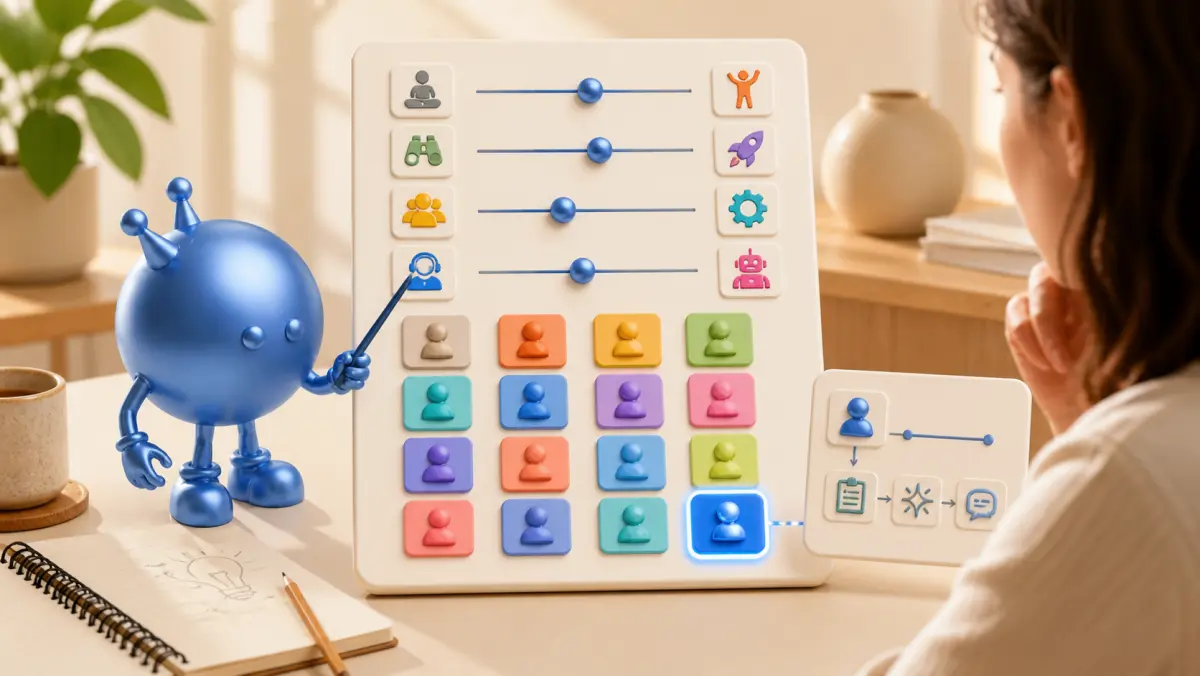
Its questions explore whether you tend to develop ideas privately or through expression, explore possibilities or move towards execution, focus first on people or systems, and prefer close guidance or greater delegation within boundaries.
Treat the result as a starting way to work with a Mind, not as a fixed identity, a verdict on your ability or a prediction of job performance.
The four Mindprint axes
The current scoring model uses four paired dimensions. Each pair describes a stated preference for working with AI, not a good or bad trait.
| Axis | One end | Other end | What it describes |
|---|---|---|---|
| Processing | Inward / Reflective | Outward / Expressive | Whether you tend to develop ideas privately or by expressing and sharing them |
| Work mode | Explorer | Executor | Whether you tend to open possibilities or organise work towards completion |
| Focus | Human / Relational | Systems / Systematic | Whether you attend first to people and relationships or structures and processes |
| Autonomy | Copilot / Guided | Agent-ready / Agentic | Whether you prefer closer review or greater delegation within boundaries |
People may work differently across situations, teams and stages of a project. Treat the axis positions as prompts for reflection rather than fixed descriptions.
How do the 16 Mindprint types work?
Each result combines one side of each axis. Four pairs produce 16 possible combinations, with names such as Curious Synthesizer, Silent Architect, Thoughtful Coach and Precision Planner.
This is not a ranking. No type is inherently more advanced, intelligent, employable or suitable for AI than another. The current implementation also contains rarity labels and percentages, but the reviewed sources do not establish a representative dataset or approved method for population claims, so those figures should not be presented as facts about users.
How is a result calculated?
Mindprint uses a rule-based score. Answers add points to paired categories. The product then compares each axis, applies its tie rules and maps the combined code to a named archetype.
Mindprint remains a product-personalisation model, not a clinical evaluation, diagnosis or independently validated personality measure. Results may vary with how you interpret a question and the context you have in mind when answering.
If a result does not feel useful, do not force yourself to fit it. Review the four axes and choose a first task based on the job you actually need to do.
How to use the result
- Open the Mindprint questionnaire.
- Choose one context for your answers, such as your usual work or a current project.
- Answer for your present preference, not the option that sounds more impressive.
- Read the axes before treating the archetype name as an identity.
- Use one low-risk workflow to test whether the recommendation is useful.
For example:
Prepare a weekly research brief from these approved sources. Separate facts, interpretation and open questions. Ask before adding another source.
Judge the recommendation by the usefulness of the work, not by the label alone.
Is Mindprint scientifically validated?
No validation evidence was identified in the reviewed first-party sources. The product's research page cites established work on exploration and exploitation, trust in automation, levels of automation and AI literacy. Those ideas can explain themes in the questionnaire, but they do not validate its scoring rules, archetypes or recommendations.
Do not use a Mindprint result to select, reject, rank or promote a candidate; evaluate employee performance; diagnose a psychological or medical condition; make education, insurance, credit, legal or healthcare decisions; or infer sensitive characteristics. It is a personalisation and reflection tool.
Frequently asked questions
How many Mindprint types are there? There are currently 16, based on combinations of four paired axes.
Does one type work better with AI? No such conclusion is supported. Useful AI work depends on the task, setup, information and human review.
Does a result automatically create a Mind? The current result can recommend a starting Mind, but the exact product handoff should be checked in the live experience.
Take Mindprint and use the result as a starting hypothesis, not a verdict.
Give your first Mind one clear job.
Start with a task you can review, then refine the result.